Integrity Pest Solutions approaches bed bug infestations across Riverside County with structured engineering principles rather than reactive chemical broadcasts. Bed bug thermal and targeted barrier eradication…
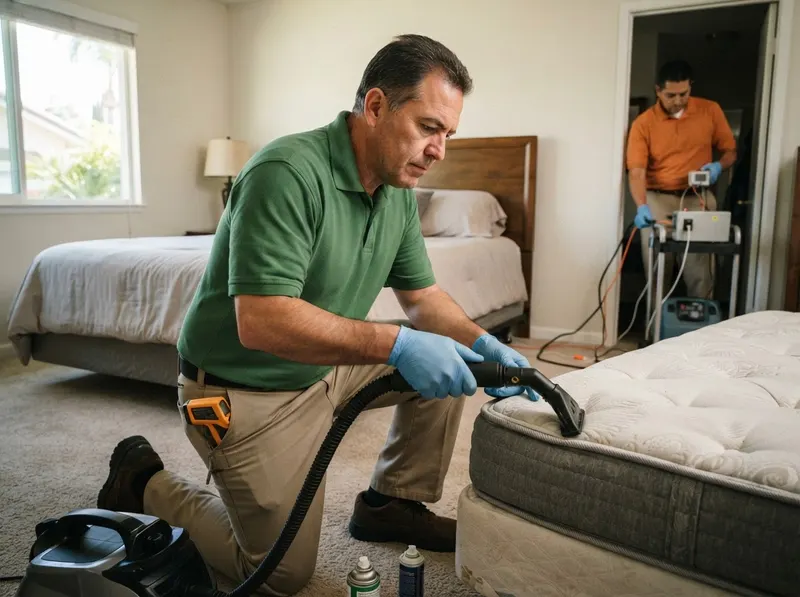
Integrity Pest Solutions approaches bed bug infestations across Riverside County with structured engineering principles rather than reactive chemical broadcasts. Bed bug thermal and targeted barrier eradication combines continuous temperature monitoring via industrial thermocouples with boundary isolation. According to the U.S. Environmental Protection Agency, heat treatments eliminate resistant strains of Cimex lectularius across egg, nymph, and adult stages when ambient core temperatures reach 122°F for at least 90 minutes. Electric and indirect-fired air heaters cycle airflow through the affected zones, monitored continuously to prevent exceeding 135°F, which protects domestic electronics and delicate vinyl window framing. Standard over-the-counter permethrin and pyrethroid foggers frequently fail because modern strains exhibit widespread metabolic resistance, often scattering insects deeper into adjoining wall cavities instead of eliminating them.
Containment protocols dictate that physical structural pathways receive mechanical isolation before heating begins. Technicians seal heating zones using tape and containment poly-sheeting compliant with standards referenced by the Centers for Disease Control and Prevention. Once thermal thresholds neutralize living colonies in mattresses and soft furnishings, an inorganic amorphous silica desiccant barrier is applied behind outlet faceplates and under carpet tack strips. Research cataloged by the Pest Control Technology technical portal demonstrates that amorphous silica dust damages the protective waxy outer cuticle of bed bugs, causing lethal desiccation over 24 to 72 hours without emitting volatile organic compounds into household indoor air.
Local housing layouts across Riverside demand distinct application methods. Two-story stucco constructions in Orangecrest and Woodcrest contain large attic heat pockets that require balanced blower placement to prevent rising heat from dissipating through roof ridges. Older raised-foundation homes throughout Arlington, Victoria, and Downtown Riverside require crawl space perimeter checks, as uninsulated floorboards create cool thermal pockets where bed bugs can seek shelter from heated living quarters. In contrast, slab-on-grade tract layouts in Canyon Crest, Hawarden Hills, and La Sierra allow focused wall-void injections adjacent to concrete baseboards. For multi-family properties near the University district and Casa Blanca, mechanical sealing around shared plumbing penetrations prevents pest dispersal into adjacent living quarters.
Property owners can evaluate whole-home thermal treatment versus isolated single-room barrier intervention based on infestation distribution. Whole-home thermal work provides absolute room-by-room clearance in a single workday, avoiding the repetitive disruption of multi-week chemical reapplications, but requires moving delicate items such as candles, musical instruments, and aerosol cans off-site. Isolated single-room containment combined with active perimeter barriers reduces client preparation and overall cost for early detections, yet demands diligent monitoring of adjacent rooms over a 30-day window to ensure female bed bugs have not crossed boundaries into unstaged spaces.
Every job gets a firm, written price after a free on-site visit.
For standards, safe disposal, and service guidance on pest control services in Riverside, CA, useful references include U.S. EPA, ENERGY STAR, U.S. Dept. of Energy, Consumer.gov, U.S. Census Bureau, and Google Maps. General consumer and small-business resources are available from USA.gov, Better Business Bureau, FTC Consumer Advice, U.S. Small Business Administration, and Ready.gov.
Tell us about your bed bug thermal and targeted barrier eradication job in Riverside and we'll send a clear, written quote, usually the same day.
 Integrity Pest Solutions