Subterranean termite colonies require direct contact with subterranean moisture to survive, building sheltered mud tubes over concrete footings to bridge the gap between nesting zones and wooden structural framing. In…
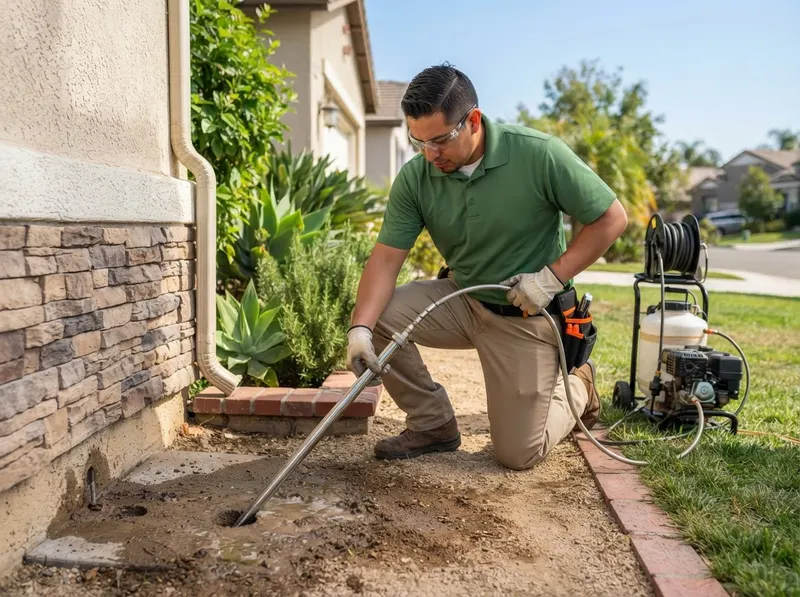
Subterranean termite colonies require direct contact with subterranean moisture to survive, building sheltered mud tubes over concrete footings to bridge the gap between nesting zones and wooden structural framing. In Riverside County, where heavy decomposed granite and compacted alluvial soils dominate neighborhoods like Canyon Crest, Woodcrest, and Orangecrest, surface repellents fail because termites track subterranean moisture seams deep below surface grade. A structural soil barrier relies on non-repellent termiticides regulated by the EPA, such as fipronil or imidacloprid, which adhere to individual mineral particles without leaching into local groundwater aquifers governed by the Santa Ana Regional Water Quality Control Board. When foraging worker termites pass through this treated subterranean zone, they transport the active compound directly back to the subterranean colony matrix via grooming and food sharing, achieving true colony suppression rather than short-lived perimeter redirection. Homeowners often attempt surface sprays using store-bought retail pyrethroids; however, these topical products merely divert termite mud tubes to hidden expansion joints, weep screeds, or sub-slab plumbing penetrations, escalating unseen structural damage inside interior drywall.
Executing a durable barrier requires strict adherence to calibration standards maintained by the Structural Pest Control Board. The installation process follows four sequential mechanical stages:
1. Exterior trenching involves excavating a continuous trench measuring 6 inches wide by 6 inches deep directly flush against the exterior concrete foundation stem wall.
2. Termiticide dispersion introduces 4 gallons of mixed chemical solution per 10 linear feet into the excavated soil trench to thoroughly saturate the profile down to the footing level.
3. Flatwork concrete drilling utilizes low-impact rotary hammer drills to bore 0.5-inch access ports spaced 12 inches apart across attached patios, garage slabs, and entry walkways.
4. Sub-slab injection delivers calibrated fluid volume beneath the slab using low-pressure mechanical injection rods before technicians seal each port with non-shrink hydraulic concrete.
Local architectural conditions across Riverside dictate distinct barrier adaptations. Along older raised-foundation residences in Downtown, Arlington, and Victoria, soil moisture remains high under crawl spaces, requiring interior stem-wall trenching alongside the exterior perimeter. Conversely, newer post-tension slab homes built across Hawarden Hills, La Sierra, Casa Blanca, and near the University corridor feature extensive continuous concrete flatwork abutting foundation perimeter walls. These slabs require precise drill-pattern mapping to prevent tension-cable damage while ensuring uniform chemical distribution over sub-slab gravel beds. Soil texture variances also alter liquid absorption rates; dense clay pockets along the California Citrus State Historic Park require slower, staged pressure injection compared to the rapid-draining coarse sand profiles surrounding the UCR Botanic Gardens or the rocky base terrain of Mount Rubidoux. Technical pest guidelines from the UC Statewide IPM Program verify that non-repellent liquid soil treatments maintain continuous active soil presence for 5 to 10 years when undisturbed by regrading or landscape trenching.
Every job gets a firm, written price after a free on-site visit.
For standards, safe disposal, and service guidance on pest control services in Riverside, CA, useful references include U.S. EPA, ENERGY STAR, U.S. Dept. of Energy, Consumer.gov, U.S. Census Bureau, and Google Maps. General consumer and small-business resources are available from USA.gov, Better Business Bureau, FTC Consumer Advice, U.S. Small Business Administration, and Ready.gov.
Tell us about your subterranean termite soil barrier treatment job in Riverside and we'll send a clear, written quote, usually the same day.
 Integrity Pest Solutions